Thursday, November 29, 2012

Thoughts on a scene from Skyfall.


I saw this image on Tumblr today, with a nice little thesis about the significance of the scene in the context of the film and our societal expectations of masculinity. I don't have too much to add to the statement, since I think it's pretty spot-on and reads the intentions of the scene perfectly. The post did make me think, though, of my experience in the theater during this scene, which was quite interesting.

When it first became apparent that Silva was kind of putting the moves on Bond, there was an instant palpable tension in the theater -- like, holy shit, is this happening to James Bond? I can't claim to be inside the minds of my fellow audience members, so I don't know for sure what everyone was thinking, but I can state definitively that the theater was collectively uncomfortable during this scene in a way that I haven't noticed when this kind of interaction happens between men and women.

When Bond quips that it might not be "[his] first time," there was an audible sigh of relief, and laughter. It was the perfect response to diffuse the tension. It made me think, optimistically, that it wasn't so much that the audience was afraid of Bond having to do "gay stuff," but that he would be actually in a powerless position in a new and uncomfortable way. Like the pictured comment says, we are so used to Bond being in control and doing and getting what he wants that maybe it was really just that we don't like seeing this character who we know and love so well being threatened with sexual assault. Maybe it had nothing to do with the fact that he is a man and his aggressor was also a man. Maybe.

Tuesday, November 27, 2012

Here's something about growing up...

I've had so many conversations recently that touch on the idea that meeting new people has somehow become tortuously awkward. I certainly feel this way, which is a somewhat new experience for me, as I've always been pretty extroverted and comfortable in social situations. Now, though, I become anxious at the thought of trying to have a decent, non-awkward conversation with someone I don't know. What on earth to I have to say to someone who doesn't already know me?

I'll be... over here.
Something else I've realized, and I don't really know if this is connected to the first thing I was talking about, (but I wouldn't be surprised if it is) is that somehow at the cusp of "adulthood" we stopped asking each other what we liked, and started asking each other what we do. As kids and teenagers, I feel like given the understanding that we were all in school, I remember trying to connect on our actual interests. We're all already sitting at the lunch table after class, so let's get into who we actually are and talk a bit about what else we have going on in our lives.

Now, though, I can bet that 99% of the time, our opening line to each other is, "So, what do you do?" And I get it. Presumably, our jobs or career pursuits take up the majority of our conscious hours, so it makes sense to start there. And that's not to mention that if you're trying to date someone, finding out what they do is treated like a good shorthand for intellectual (and economic) compatibility.

But ugh, god. I suspect that even if you are lucky enough to be really passionate about your job, it still isn't what you talk about with your friends most of the time. No, you're probably talking about other things you enjoy, common interests you have as friends, things that you've done together, good times you've shared -- most of which were not based on your mutual appreciation of your job.

I feel like part of the reason that we corner ourselves into these really stilted, awkward conversations is because right off the bat, we're asking strangers about, potentially, the most boring thing about them. How could we possibly expect to be interesting and interested in each other if the standard opening line is "What is that thing you do all day that you can't wait to get home from?"

So... what is more awkward? Continuing to have that forced dialogue about our extremely scintillating day jobs, or bucking that social norm and starting off the conversation on a different foot? Well, I think I am going to try the latter for awhile, and I'll get back to you.

Monday, November 12, 2012

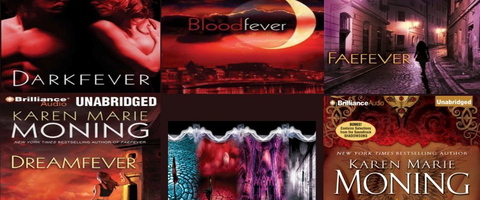
Book review: The Fever Series by Karen Marie Moning


Here’s the series, in order:
  1. Darkfever
  2. Bloodfever
  3. Faefever
  4. Dreamfever
  5. Shadowfever
These five officially complete my Cannonball (52 books in a year!) Yay! I had initially signed up to do the half-cannonball (26 books) — a formerly avid reader, I hadn’t really done a lot of reading for pleasure in the past few years, and I was unsure how many books I’d be able to cover. I want to say: THANK YOU Cannonball read, and THANK YOU Pajiba, for giving me the motivation to rediscover reading, one of my true loves in life. For the remainder of this year, I won’t be writing any more reviews, because I’ll probably be re-reading some of my favorite new books that I discovered this year.

I read these based on Malin’s reviews. I’m fairly new to urban fantasy and paranormal romance, being somewhat averse to cheese. For some reason, despite that Darkfever cover, Malin’s review convinced me to give these a try, and I’m really glad I did.

The series is set in modern-day Dublin, which due to its ancient Gaelic roots in fae magic, is kind of a “ground zero” for interactions between humans and the Fae. The heroine, MacKayla Lane, travels to Dublin with the initially simplistic idea of lighting a fire under the ass of the Dublin police, who had been previously unable to solve her sister Alina’s murder. MacKayla quickly learns that there is a lot more to Alina’s murder than she previously suspected. For one thing, she discovers that she is a sidhe-seer, or a human that can see the Fae, whereas other humans can only see the glamours that the Fae project in order to look human and blend in. Mac finds that she shared this ability with her late sister, and it was these very connections that got Alina killed.

Grappling with these revelations, Mac falls into an uneasy alliance with Jerico Barrons, the ruthless, enigmatic, and powerful owner of a Dublin bookstore. Together, they seek the Sinsar Dubh, a text about which Mac knows little to nothing, other than that the final voicemail she received from Alina implored her to locate it. Barrons has his own reasons for seeking the book, and though his motives are unclear, it is plain to Mac that she needs his help and protection if she is going to pursue her sister’s dying request.

Several other players are introduced: V’Lane, a Fae prince of the Light (Seelie) Court; Rowena, leader of a coven of other sidhe-seers; the Keltar, a clan of Druids; Dani, another sidhe-seer who grows a sisterly bond with Mac; Darroc, Alina’s former lover, and so on. With every book in the series, Mac encounters situations that force her to profoundly change. In Darkfever, she’s bubbly, naive, flippant, and astutely described by Barrons as a lamb to slaughter in the world of the Fae. With his help and her innate intelligence, she’s able to adapt, becoming quite the compelling and kick-ass heroine in the process. If you’re annoyed by her early on — DON’T WORRY. She gets so much better, and you’ll almost certainly end up liking and admiring her even by the end of the second book.

I’m leaving out a lot of detail, particularly regarding the later books, because I don’t want to reveal too much and spoil anything. I would be remiss if I didn’t give lip service to the dynamic between Mac and Barrons, which starts off similarly to how you would expect a lion to interact with a hyperactive chihuahua (Mac is the chihuahua.) Initially, it seems that the only reason Barrons even tolerates her is because she has a particular gift that is uniquely and massively helpful in finding the Sinsar Dubh.  These two have some pretty steamy sexual tension throughout the series that is pretty wicked hot. Barrons himself, I can barely describe. Malin may have said it best in her review — he’s the ultimate alpha and a quintessential bastard of literature, which in a romance or romance-adjacent novel is pretty much the pinnacle of sexiness. The combination of their explosive chemistry and the compelling story made these all-nighters for me — I couldn’t put them down. I guess this kind of stuff is more up my alley than I thought it was, because the series became an instant Cannonball favorite and I re-read several parts of every book before returning them to the library, then promptly went and bought them on Amazon. Highly recommended!

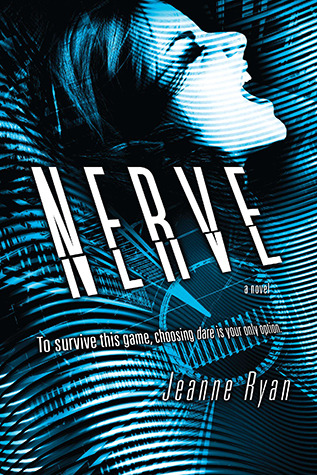
Book review: Nerve by Jeanne Ryan

Goodreads summary: “When Vee is picked to be a player in NERVE, an anonymous game of dares broadcast live online, she discovers that the game knows her. They tempt her with prizes taken from her ThisIsMe page and team her up with the perfect boy, sizzling-hot Ian. At first it’s exhilarating–Vee and Ian’s fans cheer them on to riskier dares with higher stakes. But the game takes a twisted turn when they’re directed to a secret location with five other players for the Grand Prize round. Suddenly they’re playing all or nothing, with their lives on the line. Just how far will Vee go before she loses NERVE?”

This was a pretty quick read and a rather fluffy one too. The book is set in our reality, in our time, and as such, initially the premise was intriguing. I definitely believed in the idea that such a game could exist in our time and that there would be tons of people out there that would play dares to an online audience in exchange for cash prizes. The Grand Prize round, though, seemed really farfetched to me, and as such the whole climax to the story was a yawn for me. On top of that, I didn’t really connect with any of the characters, so I didn’t really feel that invested in the “lives on the line” outcome.

The writing itself was fine, about average caliber for your typical YA novels these days. There is a prologue that felt weirdly tacked on to the beginning, and is only referenced in passing once during the rest of the book as a throwaway sentence. This was my only issue with the editing/technical side of the story.

Overall, I wasn’t super impressed with this one, but I think I may be too old for it. It’s possible that an actual teenager could relate to the characters better, and possibly believe more than I did that their peer group would willingly participate in things like the Grand Prize dare. With good YA, being slightly out of the age demographic doesn’t jar me, but here it did.

Monday, October 22, 2012

About that GMO feeding study in rats... yes, THAT one

Ever since it was published, I'd been wanting to do a takedown of Gilles-Eric Seralini's much-discussed paper finding that rats fed Monsanto's Roundup corn developed tumors at a greater rate than a control group of rats fed non-GMO (genetically modified organism) corn. It turns out I don't really need to write my own article, since plenty of people have done a great job of writing it for me. I really liked this one from the LA Times by Michael Hiltzik.

I'm going to do some choice copy and pasting here:
The research in question is a paper published a few weeks ago by a team led by French biologist Gilles-Eric Seralini. Its findings were explosive: Laboratory rats fed for up to two years on genetically modified corn of a type widely used in the U.S. developed huge, grotesque tumors.

The paper claimed to be "the first detailed documentation of long-term deleterious effects arising from the consumption" of the corn. Seralini found very similar effects in rats fed high dosages of Roundup, a widely used pesticide that the corn had been engineered to tolerate, and in rats fed a combination of the corn and Roundup.
Holy crap, one might rightly think. That's terrifying. But remember that thing I wrote about a few weeks ago about how something being published doesn't necessarily mean it's correct, true, or backed by good science, and that's why we need more double-checking of our colleagues' work? Unfortunately, Seralini's paper is so obviously flawed that even a grad student like myself could pick out mistakes, and I'm astonished it was published at all. For one thing, even the way that it is being billed as some kind of vanguard study, for the first time observing the effects of GMOs in the diet, is entirely false (emphasis mine):
By the way, Seralini's paper isn't the first long-term study of genetically modified foods in the American diet, by a long shot. The same journal that published Seralini's paper (Food and Chemical Toxicology) published a survey of 12 studies of genetically modified corn, soybeans and rice tested on rats, cows, salmon or monkeys for up to two years, and in general found no evidence of any health hazards.
So in stark contrast to the fantastical findings in Seralini's paper, twelve other studies in other animals over the same duration found nothing, and that's just in one journal. This is an anti-GMO argument I see a lot -- for some reason there is this idea that there isn't research being done on the effects of GMOs. I don't know where people are getting this information, because there are tons of studies, both past and present, that mostly show nothing. Seralini's is an astonishing exception.

But okay. Let's not just dismiss it based in it being a lone voice of opposition against a stack of contrasting evidence; after all, sometimes you only need one iconoclast to drastically alter knowledge. Hiltzik nicely broke down the issues with the paper itself:
Among the most common critiques of the experiment is that Seralini used an insufficient number of control rats — 180 test rats were fed genetically modified corn, Roundup or both, but only 20 control rats were fed a purportedly normal diet. Critics say that's too small a control group to be statistically valid.
Of course you'll see more tumor growth in a group that's nine times as large as another group. The proportions are so off that the scientific community dismisses even percentage-based differences between the two groups, because those differences will be more likely to be due to chance. In fact, I could find no evidence in the paper that the authors even tested for statistical significance in the mortality and instances of tumor development between groups. This is a huge -- HUGE! -- red flag. They use misleading statements like "In the female cohorts, there were 2–3 times more deaths in all treated groups compared to controls by the end of the experiment and earlier in general." Announcing from which group rats died earlier is a completely meaningless statement when one group has 180 possible rats that can die and another group only has 20; furthermore, the phrase "2-3 times more deaths" is a tricky phrase because it sounds bad, but it actually only indicates quantity. Saying "2-3 times as likely to die" would indicate tested  -- and (hopefully) verified by statistical significance -- increased odds of death, but "2-3 times more deaths" only means 2-3 times as many rats died in the treatment groups than the control groups, which is again a big DUH since 180 rats vs. 20 rats, well -- you get the picture.
Moreover, the researchers identified no dose-related response: The rats fed higher doses of pesticide or GM corn didn't consistently get sicker than those fed lower doses. In fact, some rats fed higher doses did better than the others.

Seralini offered no explanation why rats fed a pesticide should show the same pathology as rats fed genetically modified corn but not the pesticide, although Roundup and genetically modified corn are totally different things with, one would presume, different effects on the organism. That points to another shortcoming of the paper, which is that there's no explanation or even hypothesis of why either impurity should produce the tumors Seralini found.

"They don't show a plausible biochemical or molecular mechanism for the effect," observes Kevin Folta, a plant biologist at the University of Florida who has written critically about the Seralini paper. "It happens with two completely independent treatments, the herbicide and the [genetically modified] product, and to get the same unusual response from both is beyond suspicious."

The ultimate complicating factor is that the strain of lab rat Seralini used is predisposed to tumors, especially mammary tumors. By about 2 years of age, 80% of these rats will have them, on average. Therefore, the longer the experiment proceeds, the cloudier the data become, because most of the rats would eventually be tumor-ridden anyway. In other words, the length of the study isn't a virtue, as Seralini contends, but may be a flaw.
The dose-response and lack-of-mechanism stuff is bad, but not ultimately completely damning. Papers are published all the time that show some kind of association, but don't yet propose a causal mechanism in the body that explains the observation. Usually, what that means is that the scientific community accepts such a paper as an interesting observation worthy of further study, not as a dogmatic assertion of biological truth, and that's an important distinction against the reception of this paper: this is suddenly being treated by the anti-GMO crowd like absolute truth, even without those biological explanations, and that's bad.

And why isn't there a really viable biological explanation for Seralini's observations? Hello! Did you see that last paragraph? Allow me to repeat: "The ultimate complicating factor is that the strain of lab rat Seralini used is predisposed to tumors, especially mammary tumors. By about 2 years of age, 80% of these rats will have them, on average." Consider that with the fact that, as the article mentions, Seralini's control group was tiny, and you've got a pretty obvious foregone conclusion. Of course rats that grow tumors anyway will grow tumors when you feed them, well, anything.

Regarding Prop 37 itself, which Hiltzik argues against in his article: the scientist in me thinks it's really silly, because in my view the arguments against GMOs hedge into woo-based misinformation about how it has to be bad for you because it's not natural. It's that, or else people don't like Monsanto so they lash back at their GMO products. The pragmatist in me, though, thinks people can just have their labeled food. They can choose to eat what they want, even if it's based on exaggerated misinformation, because why not. In most other instances, I support people's decisions to control matters regarding their own bodies (being pro-vaccination is a notable exception.) I'm not entirely convinced, as the No on 37 lobbyists claim, that it will lead to increased food taxes/costs, but that's something I'll need to look into a little more. In short, I can't really endorse this proposition, because I feel it's based on quackery and fluff, but if labeled food increases the precious comfort and perceived bodily autonomy of the people of California, then all right hippies -- have at it.

Sunday, October 14, 2012

Team America GIFs

I put these on my Tumblr, but I wanted to stick them here too. In case anyone needed a little more "America, Fuck Yeah" in their lives.


Book review: The Mortal Instruments 1-3 by Cassandra Clare

This review covers the “original” trilogy of The Mortal Instruments: City of Bones, City of Ashes, and City of Glass. More books have been written and the series is up to five now; I have no idea how long the author intends for the series to run at this point.


Look at those covers — aren’t they kind of hilarious? Anyway, being the dedicated Tumblr user that I am, I couldn’t help but notice the fervor over these, particularly with the movie adaptation currently filming and slated for release in spring 2013. Turns out, I’m way behind on this phenomenon, since City of Bones was first released in 2008. Anyway. Onto the actual review-y stuff.

Set in modern New York, the series concerns the re-education of “mundane” Clary Fray, who grew up much like you and I, blind to the supernatural worlds that exist intertwined with ours. That changes one evening at a nightclub when she witnesses a group of Shadowhunters engaged in a bit of demon-slaying. Shadowhunters are humans that are angel-blessed and have the ability (and responsibility) to fight demons and other forces of evil. Shadowhunters are born only from the established bloodline of known Shadowhunters, so when the supposedly-normal Clary is able to see what ordinary humans, called “mundanes,” cannot, the Shadowhunter group takes her back to their lair. Meanwhile, her mother is kidnapped, as it turns out, by demons, and Clary and her new companions, along with her other mundane friend Simon, learn Clary’s true heritage and begin a quest to rescue her mother.

This is basically the setup for the first three books in the series, which has everything you would expect from a supernatural YA series: the epic and passionate romance that appears delayed by insurmountable circumstances and kind of leads to a love triangle, except that you’re never quite convinced that there is really any competition; the showdown between good and evil, which in this case is led by a former Shadowhunter-turned-bad; appearances from vampires, warlocks, werewolves, and faeries — etc, etc. There is also a lot of meta humor and current pop culture references, which make the books fun now but will probably lead to them seeming really dated in another few years.

Overall, yes, these were really fun. I read all three over the course of a single weekend, and I can understand why teenagers (aka, the actual target market for YA) have gone rabid over them. I really enjoyed the world-building and fast paced plot, both of which kept me engaged and caused me to want to zip through these quickly. The romance was fun too, due to a legitimately surprising twist, which keeps them “apart” for a good 2/3 of the trilogy and makes for some deliciously conflicted sexual tension. The writing itself was kind of hokey and immature, and didn’t really achieve the same kind of character depth or development that, say, Collins does in The Hunger Games, or even that THG would-be competitors like Divergent (Roth) do. What the characters lack in depth, though, they make up for in sassy quips. Again, these lend themselves to fun, quick reads rather than truly thought-provoking YA, but I’m not really complaining. One of the things that the Cannonball has done for me is taken away a bit of my prejudice regarding “serious” books. If I’m trying to read at least 52 books in a year, I owe myself a few silly fun ones along the way! So that’s what I recommend to my audience. The Mortal Instruments make a great palate-cleanser if you're used to reading more serious stuff: you’ll probably enjoy them, even if they don’t “stay with you,” as they say. And if this kind of stuff is actually right up your alley, you've probably already read them, since like I said, I'm late to this game.

Wednesday, October 10, 2012

Book review: Into Thin Air by Jon Krakauer

Description from Amazon: “Into Thin Air is the definitive account of the deadliest season in the history of Everest by the acclaimed journalist and author of the bestseller Into the Wild. On assignment for Outside Magazine to report on the growing commercialization of the mountain, Krakauer, an accomplished climber, went to the Himalayas as a client of Rob Hall, the most respected high-altitude guide in the world.  A rangy, thirty-five-year-old New Zealander, Hall had summited Everest four times between 1990 and 1995 and had led thirty-nine climbers to the top. Ascending the mountain in close proximity to Hall’s team was a guided expedition led by Scott Fischer, a forty-year-old American with legendary strength and drive who had climbed the peak without supplemental oxygen in 1994. But neither Hall nor Fischer survived the rogue storm that struck in May 1996.

Krakauer examines what it is about Everest that has compelled so many people — including himself — to throw caution to the wind, ignore the concerns of loved ones, and willingly subject themselves to such risk, hardship, and expense. Written with emotional clarity and supported by his unimpeachable reporting, Krakauer’s eyewitness account of what happened on the roof of the world is a singular achievement.”

I don’t really have a lot to add to the official description, as this is a nonfiction memoir, so a lot of the “stuff” I assess and critique in fiction are off the table here. I will note that Krakauer is an exceptional writer, so reading this does have the feel and pace of reading a suspenseful novel. It’s obvious that, as a reporter, Krakauer has made a point of gathering as much information and as many interviews as he could, and doing so has resulted in — what seemed to me to be — a comprehensive, insightful, empathetic, and reasoned take on the events of May 10/11, 1996. Into Thin Air is not without its controversy and detractors, but I think for his part Krakauer was able to elegantly cover a very sensitive subject.  In addition to the straightforward recollection of the summit attempt, Krakauer also engages in fascinating personal reflection and reveals a great deal of his own survivor’s guilt and grief. And, even though I know everyone loves to play psychologist on the internet, I wouldn’t be surprised if his emotional state after the disaster could be considered straight-up PTSD.

The way this book has written gives it wide-ranging appeal beyond the obvious target group of mountaineers and lovers of the outdoors. Though this bestseller is some 15 years old at this point, it’s well worth a read if somehow you, like me, had managed to miss it up until now.

Really, Spotify?

I was going to call this More Things I Do Not Need, but since both of the things I do not need so far have involved Spotify, I'm just going to be more direct.

I do not need the auditory assault that is the advertisement for Bruno Mars' new album. This alone wouldn't be cause for complaint, since Spotify has so far proven itself to be notoriously bad at targeted advertising, and thus constantly feeds a stream of music-related ads at me that, if it actually paid attention to what I listen to, it would know I do not want.

What makes this egregious is that Bruno Mars, he of the ill-advised grenade catching and insipid crooning about love as best understood by a 14 year old, has decided that the album cover that best represents his swag is some lady's decolletage. And Spotify has decided to make this image HUGE on my computer. Do I need to reiterate:

I AM AT WORK!

Do they not understand how many people use this service at work? And that I'd prefer not to have a huge picture of that on my screen when I go to the app? 
 

For this latest dunderhead move, Spotify gets three out of three exasperated Judge Judys.

Monday, October 8, 2012

According to someone every day, music dies

Hey guys, did you hear? Indie is dead! I don't usually follow HIPSTER RUNOFF, which is basically what it sounds like. It covers hipster music and "culture" (have we defined what hipster culture actually is yet?), usually in tiresome and off-putting ironic lolspeak and hyperbole. If hipsterism is, at least in part, trolling earnestness, i.e. desperately pretending not to care about something you really care about and doing everything in the name of irony, then HRO exists to troll hipsters by being hipster at hipsters. Have I lost you yet? Good. You just, like, don't get it, man. Appropriately, then, the site has heralded the end of indie, and the article was brought to my attention by Yeasayer's facebook page, with the caption "Someone telling it like it is -- how do we make a change?"
Here we are in the content farm era where Pitchfork, Rolling Stone, SPIN, HIPSTER RUNOFF, Brooklyn Vegan, AbsoluteIndieMag.biz, Stereogum, Buzzfeed Music, Shitty McBlogBlogMagazine.com/Music, GVB, FADER, Complex, [other random ass blog/dumb website/magazine] all generally post the same stuff. It’s just a matter of creating brand loyalty via aesthetics and the perception of premium content to lemming ass internet users.
Maybe just make something that people can share on Facebook to controversially discuss amongst their friends.
The demand for ‘innovative’ content has formed a buzz bubble. Chillwave and sponsored-content-wave artists were the main beneficiary of this bubble (post2k.5-2k11), but now, so many bands are getting a taste of alleged buzz ‘before they are ready’/before it even means anything in a legitimate context. The buzz machine is broken because there is no trusted, fail proof mechanism to create pure buzz.
There is truth in this. Bigger emerging 'indie' artists don't stay 'indie' for very long anymore, and there is no discernible delineation between 'mainstream' press like Rolling Stone and 'hipster' press like Pitchfork or HRO. So you get bands that, by and large, should be indie bands, but they're suddenly already famous before they've even really done anything noteworthy. This article namedrops Lana Del Rey, Purity Ring, and Grimes as examples of this.
I’m not sure if I have unreasonable expectations. There just has to be a new way that bands can ‘become bands’ other than ‘getting on the same set of websites that will issue predictable opinions on them.’ Or maybe a website can offer a new way of presenting bands without standardized commentary. Perhaps ‘streaming services’ like Spotify and Pandora have become those to some extent. Those appeal to the people who ‘just want the music’ without needing to know the context.
I guess what all this means, really, that what is happening is an acceleration of the cycle that we already knew existed: sometimes indie bands outgrow indie and enter the mainstream. But HRO's argument, I guess, is that bands used to have to actually prove themselves before that happened, and it was a critical mass of fan-generated buzz that elevated them, not prematurely fawning articles from music publications desperate to discover the next big thing. So indie bands now are less about the music they produce and more about their capacity to generate interesting content for the press that covers them.


ALL THAT SAID. They haven't really convinced me that this is a thing that has broken indie beyond repair. Theorem:
  1. Music speaks for itself
  2. Taste is subjective
That is, if a band sucks, then we are in agreement: it sucks! And life goes on. Unless it doesn't actually suck that bad, and a lot of people end up liking it, even if the critics don't (which happens all the time. And life goes on.)

And here is kind of the main point. Purely as a consumer of music, I have very little motivation, outside of the impetus to maybe appear 'cool' or 'scene,' to double-check the credible indieness of whatever group I've just become interested in. Like, what does this even mean?:
Maybe the indie experiment only existed to create Grimes, the ultimate internet content producer who makes content directly aimed at internet viewers. She is the best example of ‘not being a band/musician’, but instead a ‘playing by the rules’ content generation machine that resonates with humans wasting time on the internet.
 I'm not sure I even really care to understand. This is fun:


What I want from music is to like the sound, and (ideally, but not always) for it to speak to me personally in some way. The fact that the artist didn't burst out of a cocoon of spiritual enlightenment with this song on her self-actualized lips means nothing to me if it can still manage to evoke something in me. Sometimes artists write songs for themselves, and sometimes they write them for the people who are listening. Am I being manipulated because I like songs by someone who is "not a band/musician" but rather a "content generation machine"? I don't know, and I don't care. I've passed that point in my life where I need to measure the music I like by anyone's coolness barometer other than my own, thank god.

Ultimately, I'm not too concerned about this article. Like I said in the first paragraph, HRO is a meta hipster troll site, and though there has been a noticeable shift in the way that indie buzz is created and distributed, I am pretty sure life will go on, music will be made, and I'll find something to like. I kind of wonder why Yeasayer felt like they needed to signal boost the article, but trying to analyze the intentions of a band as frequently oblique as Yeasayer is a fruitless endeavor.