Monday, January 14, 2013

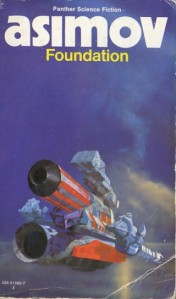
Book review: Foundation + Foundation and Empire by Isaac Asimov

I’m sorry SF fans. I’m well aware that the Foundation trilogy is classic, seminal, well-loved SF, and the Hugo “Best Series of All Time” and all that… but I didn’t like these books at all.

In a very quick summary, the trilogy concerns the establishment of the Foundation, which was apparently conceived as a scientific enterprise tasked with documenting all of the knowledge of the galaxy in a Galactic Encyclopedia. Shortly after its initial settlement on a remote planet, it is revealed to Foundation scientists that the true purpose of the Foundation is not, in fact, simply to create the Encyclopedia, but rather to develop into the new dominant political power that will supplant the current failing Empire. The majority of the books chronicles a series of “crises” that the Foundation must overcome in order to achieve the predicted political goals of the Foundation founder and lead the galaxy out of centuries of “barbarism.”


I need to clarify quickly that I only read the first two books in the trilogy, Foundation and Foundation and Empire. I was just not enjoying them and didn’t want to trudge through the third. Both books (and the third as well, from what I’ve heard) are actually composed of short stories, which chronologically detail the circumstances leading up to and surrounding the crises and how the Foundation pulls through them. Because this is going to be a mostly negative review, I’ll start by saying what I did like. First, the world-building is first-rate. Secondly, the concept of “psychohistory,” the scientific art that propels the story, is pretty cool. I’m grabbing this directly from Wikipedia, since several editors have spent — I’m sure — painstaking hours perfecting this short definition, and it’s better than I am likely to do on my own: psychohistory is “a concept of mathematical sociology (analogous to mathematical physics). Using the laws of mass action, it can predict the future, but only on a large scale; it is error-prone on a small scale. It works on the principle that the behaviour of a mass of people is predictable if the quantity of this mass is very large (equal to the population of the galaxy, which has a population of quadrillions of humans, inhabiting millions of star systems). The larger the number, the more predictable is the future.”

In practice, what this means for the story is that a premier psychohistorian has mapped out the future of the Empire and the Foundation and has foreseen the crises that the Foundation will need to overcome in order to assume its rightful place as the dominant power in the galaxy — and that brings me to my first complaint, which, as it turns out, was apparently something that Asimov himself had anticipated when writing Foundation. Though the *idea* of psychohistory is a pretty significant contribution to our collective imaginations and the SF canon, it’s application here makes for a pretty clinical, repetitive story that lacks true conflict. Because we already know that the Foundation will emerge from the predicted crises, the crises themselves fail to hold any weight. The stories add up to “Oh no! Something bad is happening! This must be a crisis!” “Fear not, I am here to play the role of the clever hero in this tale, who will outsmart our opposition and secure victory for the Foundation!” “Oh, whew, that was a close one!” over and over again. While it’s momentarily fun to read the exact way that said hero overcomes the crisis, it’s expected. As a reader, I felt no tension, and considering the high drama of terming these obstacles “crises,” I’d like to experience a bit more of that drama for myself.

Asimov altered the formula a bit in Foundation and Empire with the introduction of The Mule, a character who alters the predicted the course of the galaxy, since his role in everything was not foreseen by the initial psychohistorian-puppetmaster. Unfortunately, even though the second novel does end up dealing in that kind of suspense and uncertainty I was hoping for from the first, I was already so tired of what I felt to be a formulaic — and frankly kind of boring — experience that I just couldn’t continue, despite the novel ending in a very unresolved place.

My other major complaint — and I’m sorry, because I know this is a more modern concern to impose on a novel of this time, but I just can’t help it — is holy shit, where are the women? When I complained about the sexism in Stranger in a Strange Land, back when I reviewed it for CBR4, what I didn’t realize at the time was that, apparently, I should have been pleased that Heinlein even bothered to include women at all! There is one woman in Foundation, and if I’m remembering correctly, she appears for about 1 page to nag at her husband and get all moony-eyed over some jewelry. And that’s it! So like I said, I guess I should have given Heinlein credit for bothering to remember that women exist, even if the way he wrote them was colored by his time. I know people will always gripe that feminists want to shoehorn women into places where they aren’t appropriate, but I can’t help but wonder why these people have the imagination to accept human civilization across a galaxy, with such cool inventions as nuclear reactors that can be worn around the wrist so as to give someone a personal deflector shield, but something like including a few women here and there (which is actually pretty realistic, hello) absolutely runs up against the edge of the fantastical things we can create. We do get a significant female character part of the way through Foundation and Empire, and though she’s exactly the kind of woman I would have expected from this book — somebody’s fancy, emotive wife, with a powerful maternal/protective instinct — I was happy to have her after 500 pages with almost nary a lady in sight. (Okay, Beyta becomes more interesting right at the end, but for most of the book, I feel my assessment is accurate, if harsh.) So, like I said, I know it may not be exactly fair to hold this book to my more modern standards, but it’s my review, damnit, and this kind of stuff is seriously distracting and alienating for me. And it’s also bullshit, quite frankly, because literature from times much earlier than Asimov’s manages to include more than one gender without patronizing them, so I reserve the right to be not impressed.

So, all of that goes to say, I’m sorry world, but Foundation wasn’t for me. I’d like to say that I can kind of understand why it has the reverence that it does, but honestly, I don’t really get it. Even if I put aside all of my lady-concerns, the completely formulaic nature of the first book (and half of the second) have me scratching my head as to why this is still considered the be THE BEST of sci-fi. It would be one thing for people to say “This was great at the time, but it hasn’t aged well,” but it seems like Foundation still tops a lot of best-of lists, and, well, I’ve read a lot better.

Book review: Leviathan Wakes by James S. A. Corey

Goodreads summary: “Humanity has colonized the solar system – Mars, the Moon, the Asteroid Belt and beyond – but the stars are still out of our reach. 

Jim Holden is XO of an ice miner making runs from the rings of Saturn to the mining stations in the Belt. When he and his crew stumble upon a derelict ship, The Scopuli, they find themselves in possession of a secret they never wanted. A secret that someone is willing to kill for – and kill on a scale unfathomable to Jim and his crew. War is brewing in the system unless he can find out who left the ship and why. 

Detective Miller is looking for a girl. One girl in a system of billions, but her parents have money and money talks. When the trail leads him to The Scopuli and rebel sympathizer Holden, he realizes that the girl might be the key to everything. 

Holden and Miller must thread the needle between the Earth government, the Outer Planet revolutionaries, and secretive corporations – and the odds are against them. But out in the Belt, the rules are different, and one small ship can change the fate of the universe. “

Read a review for this on CBR4, and thought “Aha! A space opera! I MUST read this!” I was not disappointed. Main complaints first: it was a bit unnecessarily long. There were a few chapters that, in my eyes, advanced neither the character development nor the plot. Also, and this may have been just my personal preference, but I was a lot more interested in the Holden chapters than in the Miller chapters. I’ve heard the “former superstar detective fallen from grace” narrative enough times at this point that Miller is essentially a stock character, so while I appreciate the effort to give him dimension, those parts of the story dragged in the first half. Finally, I felt that the dialogue was a bit rote and sometimes lacked finesse. To be fair, though, that’s kind of a snooty criticism, because my impression is that our main characters are mostly working-class, and more to the point, they are “Belters.” Whether raised in the Belt or relocated there, the people are depicted as being generally rough around the edges and not overly concerned with Earth and Mars standards of decorum.

All that said, I still raced through this. The book had a lot to balance: politics between interplanetary governments, sociological considerations among humans who’ve adapted to different planets, interpersonal relationships, and the central mystery that drove the plot forward. For a “space opera,” the scope here is still relatively small; everything takes place within our solar system. I found this intriguing, as it suggested at a plausible less-distant future. Idiomatic and physical differences between planetary “races” are given consideration as to how the characters interact and perceive each other, and there are realistic (and relevant) discussions of the effects of different levels of gravity on the human body. Though sci-fi is often allegorical, with its more imaginative events and concepts paralleling our real-world issues, this book felt even more immediately relevant.

Leviathan Wakes is equal parts noir, horror, science fiction, and classic drama. It doesn’t shy away from gruesome description in some parts, and it depicts a range of realistic human responses to the atrocities portrayed. I also, personally, enjoyed the gender politics. A lot of the “classic” sci-fi falls really short in this aspect (see: my upcoming review for Foundation) and is, unfortunately, a massive obstacle in my overall enjoyment. I mean, you create this whole universe and can’t imagine equality in it? But I digress; Leviathan Wakes avoids similar pitfalls. Overall, I’d recommend this. I think it’s great modern sci-fi, and I understand that (like everything else) it’s part of a series, so I’ll probably be picking up the next installment.

Wednesday, January 2, 2013

Happy 2013...

Symbolic of nothing outside of its exact context, this is an accurate representation of my NYE weekend...


Wednesday, December 26, 2012

Another tick in the "pros" column for self employment

When we talk about things like rape culture, the corollary to telling women that we are responsible for keeping our dress and behavior appropriate, so as to ensure we don't get raped, is that under this logic, men are basically reduced to animals who can't process a rational stream of thought outside of "SHORT SKIRT MUST SEX." Like, if a woman is wearing a short skirt, it's her fault she was raped because the dude just couldn't help himself. This, we must point out, is a pretty awful stereotype of men, no? Men don't like to be stereotyped as potential rapists and deviants, and after all, they remind us, most men are NOT raping women.

The rest of this post isn't going to be about rape, but it is going to be how that whole rape culture attitude trickles down in the rest of our lives. Apparently, the Iowa State Supreme Court issued a decision that allows bosses to fire employees on the grounds of an "irresistible attraction."
In the case at hand, James Knight, a dentist in Iowa, fired one of his female employees, Melissa Nelson, in the interest of saving his marriage. Apparently the good doctor’s wife caught on to the fact that he wanted to fill his assistant’s cavities, and demanded that Nelson be fired immediately. If “filling cavities” is too broad a term for you, we’ll break it down with some factual tidbits taken from the opinion (available in full on the next page):
  • Knight complained to Nelson that her clothing was too tight, revealing, and distracting, but Nelson denied that her clothing was in any way inappropriate.
  • Nelson was supposed to know that her clothing was too revealing if she caught a glimpse of Knight’s err… dental instrument… standing at attention, and later told her it was a good thing she didn’t wear tight pants, because then he’d “get it coming and going.” Lovely.
  • Knight told Nelson that her dull sex life with her husband was bringing him down, noting, “[T]hat’s like having a Lamborghini in the garage and never driving it.” Knight likely had a case of the sads because he was unable to test drive the exotic thing of luxury between Nelson’s legs.
  • Knight once asked Nelson how often she orgasmed, because that’s totally appropriate.
So basically, this guy was sexually harassing his employee, but in a bizarre twist of events, he fired her for being too sexy and her termination was validated by the State Supreme Court. The Above the Law blog has a nice, succinct summary, but the full text itself really is full of gems.

And this is why I had that super serious first paragraph about rape culture. No one raped Melissa Nelson, but she lost her job because her male boss (and the male boss's wife) was concerned about the *possibility* that he might not be able to control himself around her. And the court said that was okay. Sorry Iowa ladies! Your employment is not nearly as important as the insatiable pantsfeelings of your male boss. It's your fault you're attractive? What did you expect, trying to go and have a job anyway?

I could keep going with the snark, but really, I don't have to. This is stupid enough on its own without me needing to highlight it with italics and hyperbole.

Wednesday, December 5, 2012

Derailed

This post is going to be of a more personal nature, so I'm putting it behind a cut. If you're not all about that Livejournal shit, you'd best skip over this one.

Thursday, November 29, 2012

Thoughts on a scene from Skyfall.


I saw this image on Tumblr today, with a nice little thesis about the significance of the scene in the context of the film and our societal expectations of masculinity. I don't have too much to add to the statement, since I think it's pretty spot-on and reads the intentions of the scene perfectly. The post did make me think, though, of my experience in the theater during this scene, which was quite interesting.

When it first became apparent that Silva was kind of putting the moves on Bond, there was an instant palpable tension in the theater -- like, holy shit, is this happening to James Bond? I can't claim to be inside the minds of my fellow audience members, so I don't know for sure what everyone was thinking, but I can state definitively that the theater was collectively uncomfortable during this scene in a way that I haven't noticed when this kind of interaction happens between men and women.

When Bond quips that it might not be "[his] first time," there was an audible sigh of relief, and laughter. It was the perfect response to diffuse the tension. It made me think, optimistically, that it wasn't so much that the audience was afraid of Bond having to do "gay stuff," but that he would be actually in a powerless position in a new and uncomfortable way. Like the pictured comment says, we are so used to Bond being in control and doing and getting what he wants that maybe it was really just that we don't like seeing this character who we know and love so well being threatened with sexual assault. Maybe it had nothing to do with the fact that he is a man and his aggressor was also a man. Maybe.

Tuesday, November 27, 2012

Here's something about growing up...

I've had so many conversations recently that touch on the idea that meeting new people has somehow become tortuously awkward. I certainly feel this way, which is a somewhat new experience for me, as I've always been pretty extroverted and comfortable in social situations. Now, though, I become anxious at the thought of trying to have a decent, non-awkward conversation with someone I don't know. What on earth to I have to say to someone who doesn't already know me?

I'll be... over here.
Something else I've realized, and I don't really know if this is connected to the first thing I was talking about, (but I wouldn't be surprised if it is) is that somehow at the cusp of "adulthood" we stopped asking each other what we liked, and started asking each other what we do. As kids and teenagers, I feel like given the understanding that we were all in school, I remember trying to connect on our actual interests. We're all already sitting at the lunch table after class, so let's get into who we actually are and talk a bit about what else we have going on in our lives.

Now, though, I can bet that 99% of the time, our opening line to each other is, "So, what do you do?" And I get it. Presumably, our jobs or career pursuits take up the majority of our conscious hours, so it makes sense to start there. And that's not to mention that if you're trying to date someone, finding out what they do is treated like a good shorthand for intellectual (and economic) compatibility.

But ugh, god. I suspect that even if you are lucky enough to be really passionate about your job, it still isn't what you talk about with your friends most of the time. No, you're probably talking about other things you enjoy, common interests you have as friends, things that you've done together, good times you've shared -- most of which were not based on your mutual appreciation of your job.

I feel like part of the reason that we corner ourselves into these really stilted, awkward conversations is because right off the bat, we're asking strangers about, potentially, the most boring thing about them. How could we possibly expect to be interesting and interested in each other if the standard opening line is "What is that thing you do all day that you can't wait to get home from?"

So... what is more awkward? Continuing to have that forced dialogue about our extremely scintillating day jobs, or bucking that social norm and starting off the conversation on a different foot? Well, I think I am going to try the latter for awhile, and I'll get back to you.

Monday, November 12, 2012

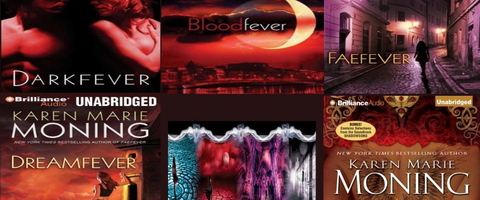
Book review: The Fever Series by Karen Marie Moning


Here’s the series, in order:
  1. Darkfever
  2. Bloodfever
  3. Faefever
  4. Dreamfever
  5. Shadowfever
These five officially complete my Cannonball (52 books in a year!) Yay! I had initially signed up to do the half-cannonball (26 books) — a formerly avid reader, I hadn’t really done a lot of reading for pleasure in the past few years, and I was unsure how many books I’d be able to cover. I want to say: THANK YOU Cannonball read, and THANK YOU Pajiba, for giving me the motivation to rediscover reading, one of my true loves in life. For the remainder of this year, I won’t be writing any more reviews, because I’ll probably be re-reading some of my favorite new books that I discovered this year.

I read these based on Malin’s reviews. I’m fairly new to urban fantasy and paranormal romance, being somewhat averse to cheese. For some reason, despite that Darkfever cover, Malin’s review convinced me to give these a try, and I’m really glad I did.

The series is set in modern-day Dublin, which due to its ancient Gaelic roots in fae magic, is kind of a “ground zero” for interactions between humans and the Fae. The heroine, MacKayla Lane, travels to Dublin with the initially simplistic idea of lighting a fire under the ass of the Dublin police, who had been previously unable to solve her sister Alina’s murder. MacKayla quickly learns that there is a lot more to Alina’s murder than she previously suspected. For one thing, she discovers that she is a sidhe-seer, or a human that can see the Fae, whereas other humans can only see the glamours that the Fae project in order to look human and blend in. Mac finds that she shared this ability with her late sister, and it was these very connections that got Alina killed.

Grappling with these revelations, Mac falls into an uneasy alliance with Jerico Barrons, the ruthless, enigmatic, and powerful owner of a Dublin bookstore. Together, they seek the Sinsar Dubh, a text about which Mac knows little to nothing, other than that the final voicemail she received from Alina implored her to locate it. Barrons has his own reasons for seeking the book, and though his motives are unclear, it is plain to Mac that she needs his help and protection if she is going to pursue her sister’s dying request.

Several other players are introduced: V’Lane, a Fae prince of the Light (Seelie) Court; Rowena, leader of a coven of other sidhe-seers; the Keltar, a clan of Druids; Dani, another sidhe-seer who grows a sisterly bond with Mac; Darroc, Alina’s former lover, and so on. With every book in the series, Mac encounters situations that force her to profoundly change. In Darkfever, she’s bubbly, naive, flippant, and astutely described by Barrons as a lamb to slaughter in the world of the Fae. With his help and her innate intelligence, she’s able to adapt, becoming quite the compelling and kick-ass heroine in the process. If you’re annoyed by her early on — DON’T WORRY. She gets so much better, and you’ll almost certainly end up liking and admiring her even by the end of the second book.

I’m leaving out a lot of detail, particularly regarding the later books, because I don’t want to reveal too much and spoil anything. I would be remiss if I didn’t give lip service to the dynamic between Mac and Barrons, which starts off similarly to how you would expect a lion to interact with a hyperactive chihuahua (Mac is the chihuahua.) Initially, it seems that the only reason Barrons even tolerates her is because she has a particular gift that is uniquely and massively helpful in finding the Sinsar Dubh.  These two have some pretty steamy sexual tension throughout the series that is pretty wicked hot. Barrons himself, I can barely describe. Malin may have said it best in her review — he’s the ultimate alpha and a quintessential bastard of literature, which in a romance or romance-adjacent novel is pretty much the pinnacle of sexiness. The combination of their explosive chemistry and the compelling story made these all-nighters for me — I couldn’t put them down. I guess this kind of stuff is more up my alley than I thought it was, because the series became an instant Cannonball favorite and I re-read several parts of every book before returning them to the library, then promptly went and bought them on Amazon. Highly recommended!

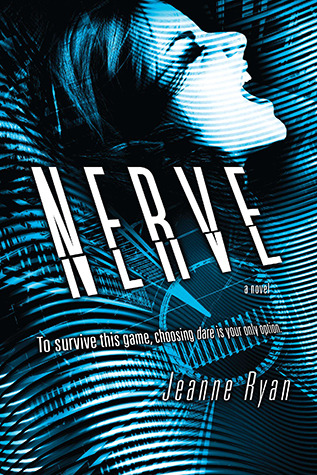
Book review: Nerve by Jeanne Ryan

Goodreads summary: “When Vee is picked to be a player in NERVE, an anonymous game of dares broadcast live online, she discovers that the game knows her. They tempt her with prizes taken from her ThisIsMe page and team her up with the perfect boy, sizzling-hot Ian. At first it’s exhilarating–Vee and Ian’s fans cheer them on to riskier dares with higher stakes. But the game takes a twisted turn when they’re directed to a secret location with five other players for the Grand Prize round. Suddenly they’re playing all or nothing, with their lives on the line. Just how far will Vee go before she loses NERVE?”

This was a pretty quick read and a rather fluffy one too. The book is set in our reality, in our time, and as such, initially the premise was intriguing. I definitely believed in the idea that such a game could exist in our time and that there would be tons of people out there that would play dares to an online audience in exchange for cash prizes. The Grand Prize round, though, seemed really farfetched to me, and as such the whole climax to the story was a yawn for me. On top of that, I didn’t really connect with any of the characters, so I didn’t really feel that invested in the “lives on the line” outcome.

The writing itself was fine, about average caliber for your typical YA novels these days. There is a prologue that felt weirdly tacked on to the beginning, and is only referenced in passing once during the rest of the book as a throwaway sentence. This was my only issue with the editing/technical side of the story.

Overall, I wasn’t super impressed with this one, but I think I may be too old for it. It’s possible that an actual teenager could relate to the characters better, and possibly believe more than I did that their peer group would willingly participate in things like the Grand Prize dare. With good YA, being slightly out of the age demographic doesn’t jar me, but here it did.